
CO₂ Monitoring in Buildings and what HVAC Professionals Need to Know
CO₂ monitoring has become a core part of modern building HVAC design, especially with demand-controlled ventilation, energy optimization, and post-pandemic Indoor Air Quality (IAQ) awareness.
Indoor air quality plays a critical role in occupant comfort and workplace performance. Elevated CO₂ levels are frequently associated with feelings of stuffiness, fatigue, headaches, and reduced cognitive function. While carbon dioxide itself is not typically harmful at normal indoor concentrations, it serves as a reliable indicator that ventilation may be insufficient for the number of people in the space.
When ventilation rates fail to match occupancy levels, indoor environments can feel stale and uncomfortable. Over time, poor air quality can contribute to decreased concentration, lower productivity, and increased occupant complaints. By maintaining appropriate CO₂ levels through properly designed DCV systems, buildings can support healthier, more comfortable, and more productive indoor environments.
Effective CO₂ monitoring combined with intelligent ventilation control not only improves energy efficiency but also enhances overall building performance and occupant well-being.
What CO₂ Monitoring in Buildings Actually Means
In typical buildings, CO₂ is not monitored because it is toxic at normal indoor levels.
It is monitored because it is a reliable indicator of human occupancy and ventilation effectiveness.
Humans exhale CO₂ continuously. If ventilation is insufficient for the number of occupants, CO₂ rises.
In HVAC terms:
- Low CO₂ → ventilation is keeping up with occupancy
- Rising CO₂ → occupancy increased, or ventilation is insufficient
- Persistently high CO₂ → under-ventilation for the space usage
This is why CO₂ is central to Demand-Controlled Ventilation (DCV) strategies described in guidance aligned with ASHRAE.
How CO₂ Is Measured in Buildings
Sensor Technology Used in HVAC
Almost all building CO₂ transmitters use NDIR (Non-Dispersive Infrared) technology.
Why NDIR is used:
- High selectivity for CO₂
- Stable over long periods
- Not affected by humidity or common HVAC contaminants
- Long service life compared to chemical sensors
For HVAC professionals, this means:
If a CO₂ reading looks wrong, the problem is usually installation or control logic, not the sensor chemistry.
Typical Measurement Ranges
Common HVAC CO₂ transmitter ranges:
- 0–2000 ppm → offices, classrooms, meeting rooms
- 0–5000 ppm → mixed-use buildings, standardization across projects
Outdoor air baseline is typically ~400–420 ppm
Standards, Norms, and the “CO₂ Limit” Myth
One of the most common misunderstandings in HVAC is the idea of a fixed “acceptable indoor CO₂ limit”.
Important clarification:
- Modern ventilation standards do NOT define a maximum allowable indoor CO₂ concentration for comfort or compliance.
- CO₂ is used as a design and control parameter, not a pass/fail criterion.
ASHRAE standards focus on:
- Required outdoor air rates per person and per area
- Acceptable IAQ through ventilation effectiveness
- Use of CO₂ for DCV when properly designed
The often-quoted “1000 ppm limit” is a historical guideline, not a current code requirement.
What CO₂ Levels Mean in Practice
|
CO₂ Level (ppm) |
Practical Interpretation |
|
400–600 |
Outdoor or very lightly occupied |
|
600–900 |
Well-ventilated occupied space |
|
900–1200 |
High occupancy, ventilation catching up |
|
>1200 |
Likely under-ventilated for current occupancy |
Importance of Demand-Controlled Ventilation (DCV)
Demand-Controlled Ventilation, commonly referred to as DCV, is the primary reason CO₂ sensors are installed in modern commercial buildings. This strategy adjusts the amount of outdoor air supplied to a space based on real-time occupancy levels. Instead of running ventilation systems at full capacity all day, DCV allows HVAC systems to respond dynamically to actual demand, improving both efficiency and indoor air quality.
By monitoring carbon dioxide concentrations as an indicator of occupant density, DCV systems can significantly reduce unnecessary ventilation. This leads to lower energy consumption, reduced heating and cooling loads, and more stable indoor temperatures. Buildings with variable occupancy patterns benefit the most, as ventilation increases only when people are present and decreases when spaces are lightly occupied or empty. This prevents over-ventilation during low-occupancy periods while still maintaining code-compliant fresh air levels.
Demand-Controlled Ventilation is especially valuable in offices, schools, universities, conference centers, and auditoriums, where occupancy can fluctuate dramatically throughout the day. In these environments, traditional constant-volume ventilation often wastes energy by conditioning outdoor air that is not needed.
Problems Caused by Poor CO₂ Monitoring in Buildings
Poor carbon dioxide (CO₂) monitoring is one of the most common causes of indoor air quality complaints in commercial and institutional buildings. While CO₂ sensors are widely used in Demand-Controlled Ventilation (DCV) systems to optimize fresh air intake and save energy, improper installation or configuration can lead to inaccurate readings, uncomfortable spaces, and higher operating costs.
Below are the most frequent and costly mistakes in CO₂ monitoring systems — and why they matter.
1. Wrong CO₂ Sensor Placement
Incorrect sensor placement is the number one cause of false readings, delayed system response, and occupant comfort complaints.
CO₂ sensors must measure the air people are actually breathing. When they are installed in the wrong location, the data becomes misleading — and the HVAC system responds incorrectly.
Common Installation Mistakes
-
Mounting near supply air diffusers
Fresh supply air dilutes CO₂ levels, causing artificially low readings and under-ventilation. -
Mounting in return air grilles
Return air may represent mixed conditions from multiple areas, masking high occupancy zones. -
Installing near doors or windows
Outdoor air infiltration can distort readings and cause inconsistent ventilation response. -
Using one sensor for too large a zone
Large spaces or multi-use areas require multiple sensing points. A single sensor cannot accurately reflect varying occupancy patterns.
Why Proper Placement Matters
Incorrect placement can lead to:
-
Over-ventilation (wasted energy)
-
Under-ventilation (stale air and complaints)
-
Slow reaction to occupancy changes
-
Frequent comfort issues in conference rooms and classrooms
Best practice is to install wall-mounted sensors in the breathing zone (typically 3–6 feet above the floor) in representative, well-mixed areas away from direct airflow.
2. Poor Control Logic and System Integration
CO₂ sensors are often blamed for performance problems when the real issue lies in the control strategy programmed into the Building Management System (BMS).
Even a perfectly functioning sensor can create instability if the control loop is poorly configured.
Typical Control Problems
-
No signal filtering
Without averaging or filtering, normal fluctuations cause dampers to rapidly open and close (known as “damper hunting”), increasing wear and energy use. -
Over-aggressive PI tuning
Poor proportional–integral (PI) settings can make the ventilation system react too quickly, leading to oscillations instead of smooth modulation. -
No minimum ventilation limit
Systems must maintain a code-compliant baseline of outdoor air regardless of CO₂ levels. -
No fail-safe mode during sensor fault
If a sensor fails, the system should default to a safe ventilation rate — not shut down or over-ventilate.
3. Over-Reliance on CO₂ as the Only Air Quality Indicator
CO₂ monitoring is valuable — but it does not measure overall indoor air quality. It primarily indicates occupancy-related ventilation demand.
CO₂ does not detect:
-
Volatile Organic Compounds (VOCs)
-
Particulate matter (PM2.5, PM10)
-
Off-gassing from furniture or building materials
-
Humidity and moisture-related issues
-
Odors unrelated to human respiration
Relying solely on CO₂ sensors can create a false sense of air quality control. A space may show acceptable CO₂ levels while still experiencing poor air quality due to pollutants from cleaning products, finishes, or outdoor pollution.
A Smarter Approach
Modern indoor air quality strategies combine:
-
CO₂ sensors for occupancy-based ventilation
-
VOC sensors for chemical pollutants
-
Particulate sensors for air cleanliness
-
Humidity monitoring for mold prevention
-
Proper filtration and airflow balancing
This multi-parameter approach improves comfort, health, and energy efficiency.
Instruments for CO₂ Monitoring – Kimo Recommendations
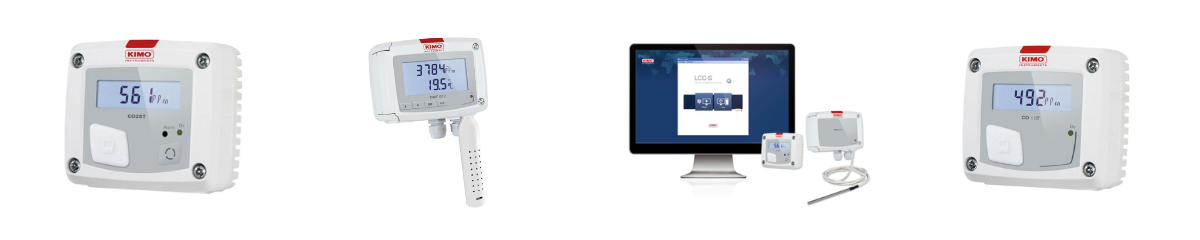
Kimo CO2ST-S – Room CO₂ Transmitter
Use when you want reliable room-level CO₂ data. It could be used for offices, classrooms, meeting rooms.
Why it fits building HVAC:
- 0–5000 ppm range
- Stable NDIR sensor
- 24 VAC/DC supply (easy BMS integration)
- Clean wall-mount design
Kimo COT212 Series – CO₂ + Temperature Transmitters
Use when fewer field devices or temperature and ventilation data are both required. Also, when installation conditions are not office-clean. Best for duct applications, technical spaces, centralized monitoring
Key advantages:
- CO₂ and temperature in one device
- Multiple analog outputs
- Relay options for alarms or control
- Higher IP rating for harsher environments
Portable CO₂ Instruments (Commissioning & Verification)
Often overlooked, but critical.
Use portable CO₂ meters to verify installed sensor accuracy, compare readings across zone or support commissioning and troubleshooting.
Best-Practice CO₂ Monitoring Strategy
For HVAC professionals, a good CO₂ monitoring strategy means:
- Correct sensor type (NDIR)
- Correct range (don’t oversize unnecessarily)
- Correct placement (where people actually are)
- Stable control logic (filtered, limited, fail-safe)
- Integration with temperature and airflow control
- Periodic verification and maintenance
Final Practical Takeaway
CO₂ monitoring is one of the most powerful and cost-effective tools in building HVAC—but only when treated as a control input, not a magic IAQ number.
If it is done right, CO₂ monitoring improves comfort, reduces energy use and makes buildings easier to operate.
If you’re planning CO₂ monitoring for a building, provide us space type, zoning approach, and controller inputs. Our sales team would be happy to help you select the right Kimo CO₂ transmitter and give placement and control guidance based on real HVAC practice.